The Matrix: A Collective (Twenty Poems)
How do poets maintain a writing practice through grief, parenting, burnout, and everything “real life” demands? How do we keep returning to the page when the world feels unwriteable?
In the early months of the pandemic, amid collapsing schedules, daily grief tallies, and a collective scramble for connection, a small miracle took root. One poet, Community-Word Project founder, Michele Kotler, invited a few women to write together over Zoom. From that modest beginning grew a circle of nearly 20 poets, known affectionately among ourselves as the Matrix.
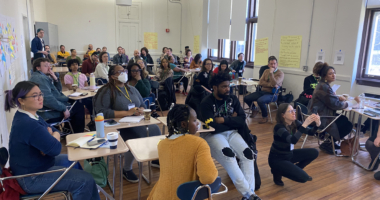
Every Friday, we gather from across time zones, climates, and life stages. Some of us arrive holding babies or breakfast plates. Others log on flushed from a work call or still in pajamas. We show up in grief, in joy, in fatigue, in hope. And we write.
The structure is simple. We begin with a check-in and the reading of a published poem brought by one of us not necessarily for its theme, but for the spark it offers: a charged image, an arresting line, a bold formal move. From our shared discussion, we generate a writing matrix: a grid of several dozen words—nouns, verbs, phrases, and modifiers—culled both from the poem and our conversations about our lives and the world around us. Once the grid is built, we mute our mics, turn off our cameras, and write.
The words in the matrix are ours and not ours. Freed from context, they become constraints and invitations. They dare us toward new juxtapositions, new ways into the poem. Something about their structure—dislocated, rearranged—creates a creative rupture that feels expansive. Often a word will travel between our poems, revealing a shared consciousness. This process doesn’t take more than two hours and includes reading our fresh drafts out loud with limited but delighted gut responses.
The writing matrix was originally conceived by Michele Kotler when she was working as a teaching artist and wanted her students to experiment with language as poets do. Just as the Matrix has inspired young writers it has also taken this collective of women writers in new directions.
Over time, the Matrix has grown into something more than a weekly practice. What began as a pandemic ritual now includes biannual writing retreats, book manuscript review sessions, public readings, and talk of an anthology. Many of us have published poems or books since joining. Our friendships have deepened. We’ve sustained each other through life’s ordinary interruptions and its extraordinary shifts– illness, divorce, birth, death, celebration, creative droughts, and personal breakthroughs. There’s no payment, no hierarchy, only the ongoing work of witnessing, writing, and celebrating each other’s voices.
There is intimacy in returning week after week to write and share raw drafts. There is tenderness in holding silence, in witnessing someone cry or light up mid-line. We’re a group built on trust. In a literary scene that can feel cutthroat, it’s rare to find a space where you can actually take risks without performing. This is that space.
These poems aren’t “about” the group, but they carry its trace. They are evidence of what can emerge when poets meet consistently, with no agenda but to write and witness.
The following selection of poems from the American Poetry Review are written by alums of the Teaching Artist Project, some of whom also taught for Community-Word Project.
semantics
– Felice Belle
i use ‘want’ and ‘need’ interchangeably
my therapist interjects,
want is jewelry, need is bread
i am obsessed
with want
like a greedy toddler
give me cheesecake
and nicotine
no bedtime
supermarket aisle screams
what i need is non shifting
tectonic plates, certainty
of sunrise, someone to hold
my stuff
what i am is
a sewer of sarcasm,
placeholder prayer
you can douse longing
with boone’s farm and it will blaze
like lighter fluid on a grill
even if it’s not what you need
no one teaches you how
to walk away
from what you love
I CAN’T RIGHT NOW
– Laura Cronk
I’m funding war and buying clothes
I’m clearing my inner search history
I’m busy this week but if pressed, I’d say
I’m all in and I’m making the signs
overgrown hedge, I will get to you
transparent, my neglect, my tending
well-loved children contained here
in my arms and at this work site
the moment I stroke my child’s hair
a drone finds a tent
I can’t help you, you called right? or emailed
I can’t text at the moment
my phone is a tarpit
my identity is brittle white
my breath is a moth
I scoop roughage from my purse for takeout
just enough for us with leftovers for lunch
a season of not serving my neighbor,
not serving my elders, the stranger, civilians
God, predator in the sky, moon-faced owl,
has something he wants me to see
dissipates some fog and I watch
child and stranger and husband
and neighbor collage into one
and then break apart again in my hands
What To Say When A Mom Asks If His Diet Caused It
– Catherine Esposito Prescott
Nothing is caused by nothing.
In fact, this big something was certainly
cause by something, but certainly it wasn’t
that mango he ate at perfect sweetness
minutes before rot set in. It was nothing
we placed on the table, no chicken cutlets,
no capicola, salami, prosciutto, no wicked
cheese browned on pizza, no bacon crisp.
Occasional fast food was hardly prescient.
Neither hunger unmet. The boy became a boy
with no future, no choice but in how much to suffer.
Once, after radiation, we told our son to order
whatever he wanted for lunch and as much
of it as he wanted. That’s when he knew
and we knew. That’s when our budget
disintegrated and our balance sheet shifted
to his happiness, his endurance. That day,
he ordered four entrees from his favorite ramen
restaurant: bowls of noodles and soup, fried
pork gyozas, and steamed shrimp dumplings.
It was his his win–to savor every combination
of fat and sweet and spice knowing
this pleasure would be the last to leave
before invaders claimed his brain, then his
body, spreading like brush fire to a wild rage
no wind could enter, no water blow out.
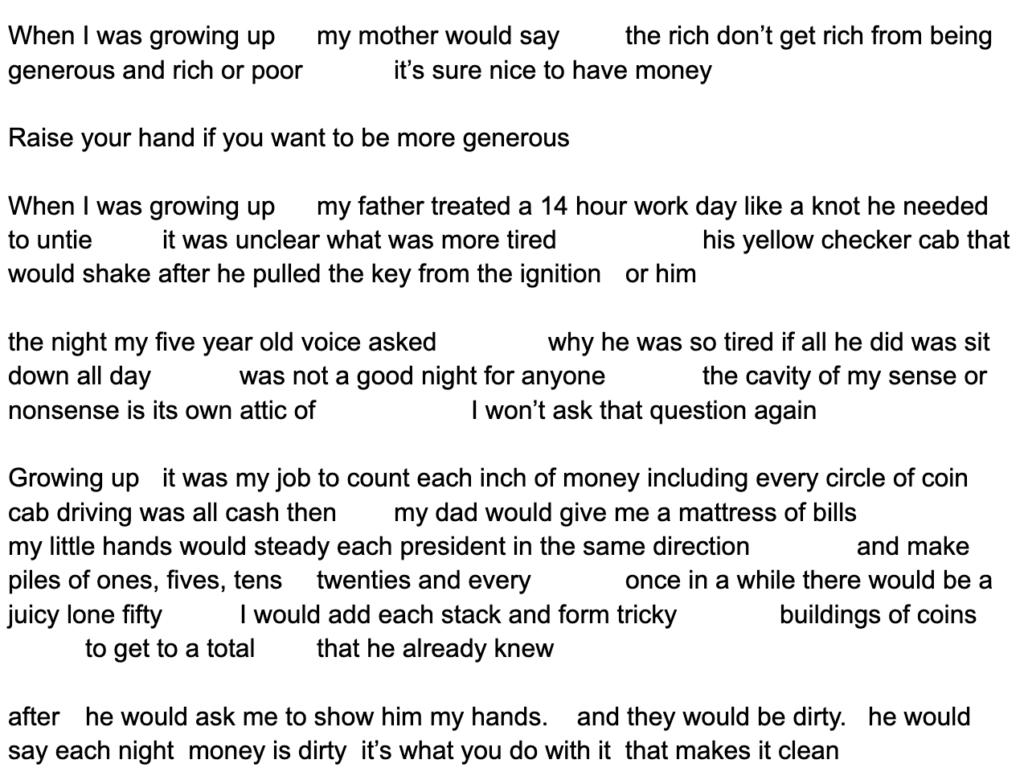
Raise Your Hand If You Want to Be More Generous
– Michele Kotler
A History
– Marina Hope Wilson
In the kingdom of childhood,
mice whispered through the house.
Their urine perfumed our cabinets
and carpets, their droppings were
scattered on our shelves.
At night, I sheltered
with these smallest of
creatures, all of us trying
to stay warm, survive
the primal hours.
What is steadfast as poverty?
Oh, right—Greed. Metal and blood.
Who flourished while we lived
behind drawn curtains and piles
of crumpled, line-dried clothes?
I could boast I was once the queen
of Chico Avenue. I paraded barefoot
and naked down the gravel driveway,
bejewelled with spit and dirt.
I wore nothing but shame.
Bios:
Felice Belle is the author of Viscera (Etruscan Press, 2023). Her writing has been published in several journals and anthologies including Oral Tradition, The Common, and UnCommon Bonds: Women Reflect on Race and Friendship. As a poet and playwright, she has performed at the Apollo Theater, Joe’s Pub, TEDWomen, and TEDCity2.0. She is a lecturer in the low-residency MFA program at St. Francis College and Artists Network Director for the global nonprofit Narrative 4.
Laura Cronk published two books of poems with Persea Books, Ghost Hour and Having Been an Accomplice, winner of the Lexi Rudnitsky First Book Prize. Her poems and essays have appeared in publications including Action, Spectacle, The Bennington Review, three issues of The Best American Poetry, Court Green, Iterant, Lit Hub, and Public Seminar. She is the poetry chair for the MFA in Creative Writing at The New School in New York.
Catherine Esposito Prescott is the author of Accidental Garden, winner of the Barry Spacks Poetry Prize (Gunpowder Press, 2023), and two chapbooks, The Living Ruin and Maria Sings. Recent poems appear or are forthcoming in Colorado Review, NELLE, and Tahoma Literary Review. Prescott is the co-founder of SWWIM and editor-in-chief of SWWIM Every Day. In addition to her work in poetry, Prescott teaches yoga philosophy and leads yoga and writing retreats. See http://catherineespositoprescott.com
Michele Kotler is a poet living in her native New York City. Her poems have appeared in Washington Square Review, Spinning Jenny, Painted Bride Quarterly and SWWIM Every Day. She is the founding director of Community-Word Project, a New York City based teaching artist training and artist in the schools organization.
Marina Hope Wilson is the author of the chapbook, Nighttime (Cooper Dillon Books, 2024). Her poems have appeared in journals such as The Massachusetts Review, $, trampset, Stirring, and SWWIM Every Day. Marina lives in San Francisco with her husband, stepdaughter, and two cats, and she makes her living as a speech-language therapist.