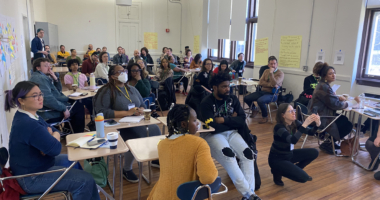
Teaching Artist Project helped us introduce new ideas into the classroom.
For our 2025-2026 Teaching Artist Project Lesson Plan assignment, I partnered with a fellow creative writer – which was exciting in combining our shared artistic forms in a way that was just as innovative as other partners who were required to contribute two very different art form specialties into the same lesson.
We created an original lesson around the theme of “Identity and Expression,” providing opportunities for students to engage in meditation and inner healing, list sensory details from focusing on their own bodies and the five senses, and write their own original ekphrasis poetry — or poetry based on a work of art, using several examples from classic and contemporary poetry.
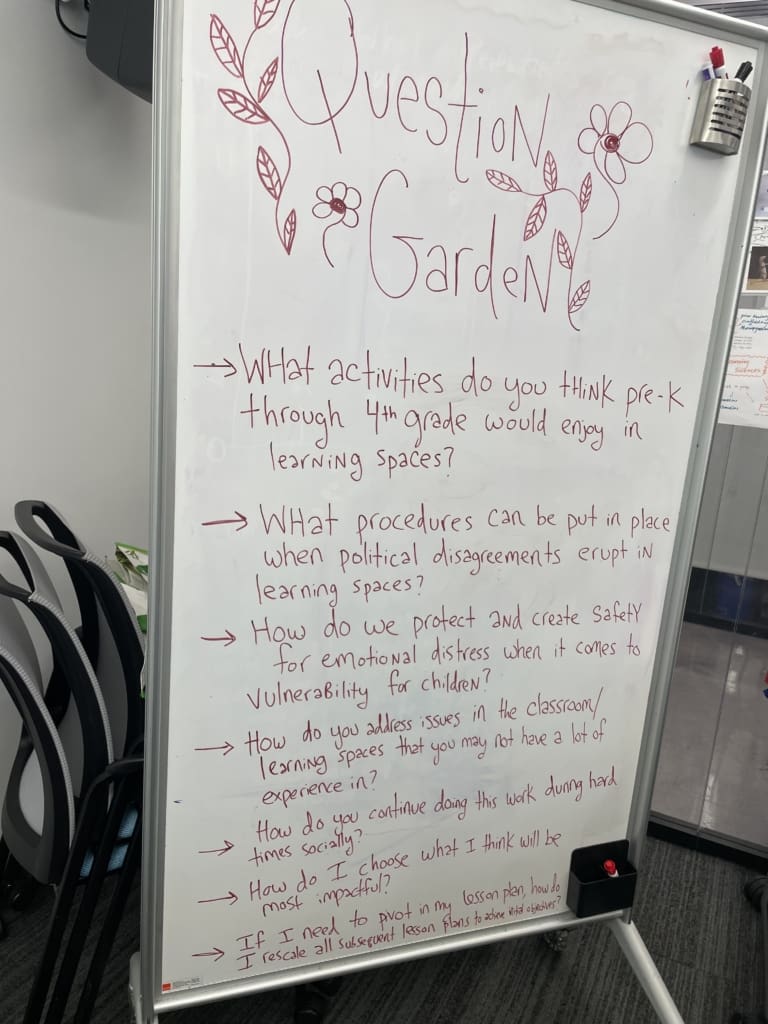
Many of the relevant poems had their artistic inspiration mentioned at the beginning of the poem in its epigraph, ranging from the paintings “Penitent Magdalene” by Domenico Tintoretto c. 1598, “L’Estaque” by Paul Cezanne c. 1883-1885, and “The Devout Childhood of St. Elizabeth of Hungary” by Charles Allston Collins c. 1851-1852, to works of film, the 2017 sci-fi-meets-Greek-mythology music video “I Feel It Coming” by The Weeknd (feat. Daft Punk) dir. Warren Fu and the 1979 film “Apocalypse Now” dir. Francis Ford Coppola.
We constructed a slideshow presentation which juxtaposed the entire texts of the shortest poems and only the titles of the longest poems, with images of the original artwork so that students can see the real world inspiration behind poetic language that may be inaccessible or more abstract than other genres such as fiction and nonfiction. Students are able to utilize multiple intelligences during meditative visualization and transfer what we as teaching artists learned throughout the semester about creative ancestors, who are the people, places, and things which inspire us as artistic educators, and creative elements, which are the craft elements and guiding issues, concepts, and themes which we explore in our work, into their ekphrastic poetry.
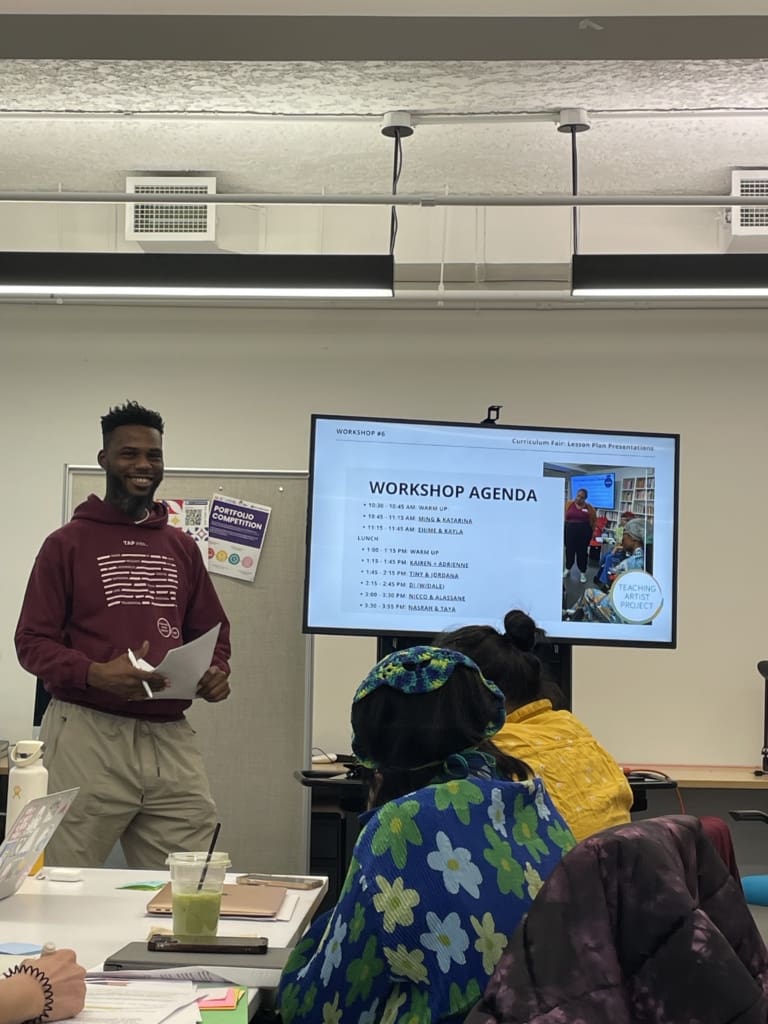
TAP provided us with a lesson plan outline to complete which allowed us to plan students’ journeys through the entire lesson with structure and efficiency, including an opening ritual, introductory activity, main exercise, closing ritual, as well as highlighting the multiple intelligences, support roles, creative skills and themes, works of art to be presented as models, backwards mapping student learning outcomes, and techniques to build a productive classroom culture necessary for a comprehensive lesson. Our target audience of eleventh graders would have found the assigned readings well suited for their comprehension level as we mimicked the educational approaches of high school English teachers in distributing works that contained advanced literary devices without being too obscure to interpret.
The classical poetry was often much more formal and concise than the modern poetry which I introduced in the form of packet handouts, which were the poems I was personally passionate about introducing due to their relevance to our students with their authors being similar in age. Instead of being structured with strict meter and couplets, my inclusion of modern youth poetry is meant to inspire high school students to think bigger about their poetic processes and maintain the confidence that they have something valuable to say at a young age.
Some of the challenges we faced was deciding on necessary materials, such as printing the poetry packets for all the participants solely at the teaching artist’s home instead of having access to the printers of a public school building, and while reciting the full body meditation was met with praise on its suitability for the end of a long workshop day, in our lesson revision we hope to gradually build students’ comfort level and reduce the meditation’s length as the first lesson’s opening activity of any artist residency. Time limitations also reduced the number of poem samples we could share, and some adjustments would be to allow a system where students have a choice on which poem they would focus on, and to provide personal work so students understand who the teaching artists themselves are as artists.
Asking the participants to list twenty observations, a technique I borrowed from my experiences at the Iowa Young Writers Workshop a decade prior, while balancing the demands of CWP’s lesson plan template and making sure the plan was cohesive and easy to use within fifteen minutes was particularly challenging. However, our collaboration sparked deeper connections among the teaching artists and students as we practiced combining real and imaginary observations using ekphrasis poem examples and meditation, with outstanding scaffolding as students were capable of transitioning seamlessly among connected activities, and received a full explanation and breakdown of the ekphrastic form.
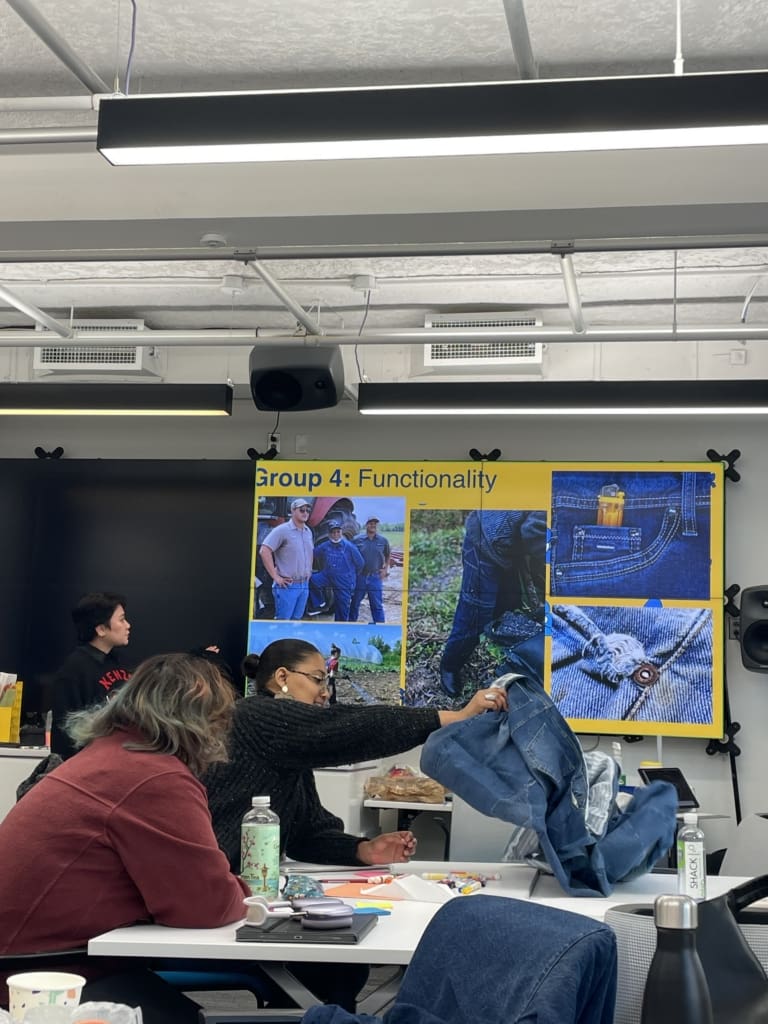
Co-planning and co-teaching are opportunities the Teaching Artist Project develops exceptionally well, and several other lessons became favorites of mine, including the opportunity to make original monuments with digital examples as creative technologists, having third graders dissect the character traits and superpowers of those who populate a graphic novel, fourth grade creative storytelling using sacred affirmations, kinesthetic movement and tableaus, and community agreements, searching for and describing personal elements in photography, and understanding the history and functions of denim.
The dynamic presentations and versatile materials available to us as teaching artists in the Teaching Artist Project helped us introduce new ideas into the classroom and test them out before we embark on our careers as educators and creators, while being inspired by our fellow artists’ advice and ability to engage all ages of students.
About the Author:
Michelle Chen takes inspiration from the events that occur in and around her home, New York City, though her birthplace is Singapore and she hopes to return and visit someday. Her work appears in Prairie Schooner, Asian American Writers’ Workshop’s The Margins, the YoungArts Gallery, Deep Wild, Kinsman Quarterly: Winds of Asia, The Evergreen Review, The Statesman, and elsewhere. Her writing has been recognized by Ploughshares Emerging Writers, the City College of New York, Brooklyn Public Library, and Penguin Random House, among others. She is an alumni of Girls in Icy Fjords, the Adroit Journal Summer Mentorship, Girls Write Now, the Juniper Institute for Young Writers, and the Iowa Young Writers’ Studio with the support of the National Society of Arts and Letters. At Stony Brook University she received the Best Masters Essay Prize, Distinguished Travel Award, and AAPI Mentorship Travel Grant where she studied abroad and taught postgraduates in the PhD Career Ladder Program, and is currently a Master’s student at NYU. She is part of the Teaching Artist Project at Community-Word Project, has acted in the BC2M-AAPI Project by Bring Change to Mind, Billion Dollar Beauty UGC Campaign x Model Mayhem, as well as indie and college feature films, and is seeking critique partners along with educational, research conference presentation, modeling, and performance collaborations, while getting less ice and less sugar in her winter melon milk tea. You can follow her collegiate book blog at silkwormreading.blogspot.com and on Instagram @michmashedpotatoes.